
Executive Summary
This report evaluates why machine-to-machine AI commerce is incompatible with traditional human-centric finance and outlines the crypto infrastructure emerging to support autonomous agents. As AI agents increasingly transact with other agents or act independently on behalf of users, they require payment rails built for speed, programmability, and autonomy. If agentic commerce scales as expected, it could represent one of the largest new economic layers of the internet, reliant not on legacy banking rails, but on stablecoins settled across high-performance blockchains such as Solana.
Key points:
TradFi Bottleneck: Credit cards and bank rails are slow, expensive, and designed for human verification (KYC, CAPTCHAs, multi-day settlement), breaking autonomous workflows.
Programmable Crypto Rails: Stablecoins and high-throughput blockchains enable near-instant settlement, sub-cent fees, and 24/7 global operation, making true micropayments viable.
x402 Protocol: Revives HTTP 402 (”Payment Required”) to embed stablecoin payments directly into the web’s request-response cycle.
Emerging Infrastructure: Stripe and Coinbase are operationalizing buyer and seller-side rails for agents.
Open Governance Layer: Google and PayPal’s AP2 introduces verifiable “mandates” to bridge user intent with programmable settlement leveraging stablecoins.
Looking Forward: AI agents and crypto rails activate the internet’s native payment layer, enabling instant, agent-to-agent economic activity and unlocking the potential for a trillion-agent economy built on open blockchain networks.
The Architecture of Machine-to-Machine Value Exchange
AI agents are evolving from passive assistants into autonomous economic actors capable of executing tasks, negotiating services, and transacting independently. This shift exposes a fundamental limitation of the internet’s financial infrastructure: legacy payment rails were built for humans, not machines. As software begins to buy from software, commerce must move at API speed — instantly, programmatically, and globally. This report argues that blockchains and stablecoins represent the missing native value layer of the internet, enabling the rise of agent-to-agent (A2A) commerce and a new machine economy.
AI agents wrap a Large Language Model (LLM) with memory, tools, and goals so they can take actions and run workflows autonomously, while an LLM by itself just reads and generates text when prompted. Many large enterprises and entrepreneurs are now deploying or piloting agentic systems. Directionally, this turns AI from a copilot that suggests work into a digital workforce that actually executes work, so the upside is in labor-like leverage (24/7 execution, cross-system orchestration) rather than just productivity per knowledge worker.
This necessitates a fundamental rethinking of the underlying payment rails that facilitate commerce. Financial systems have been engineered for human actors, relying on signatures, physical cards, and biometric authentication to verify intent. However, as autonomous agents increasingly navigate the digital web to procure and create data, compute, and specialized services, the inherent friction of human-centric systems has become a critical bottleneck.
Traditional financial infrastructure is becoming a liability in an era of high-frequency, sub-second machine interactions. Consequently, a new paradigm is forming where agents leverage stablecoins and blockchain-based protocols to transact with near-instant finality and minimal cost, enabling machines to transact as seamlessly as they exchange data.
The adoption of these programmable rails is being accelerated by industry leaders. Stripe’s introduction of machine payments, Coinbase’s rollout of agentic wallets, and the revival of HTTP 402 signal a transition toward crypto-based infrastructure.4 While traditional players like Visa and Mastercard are attempting to build walled gardens around their own agent protocols, the open, interoperable nature of crypto-native solutions offers a superior value proposition for A2A economies.11
Table 1: Comparative Analysis of Payment Rails for Autonomous Agents
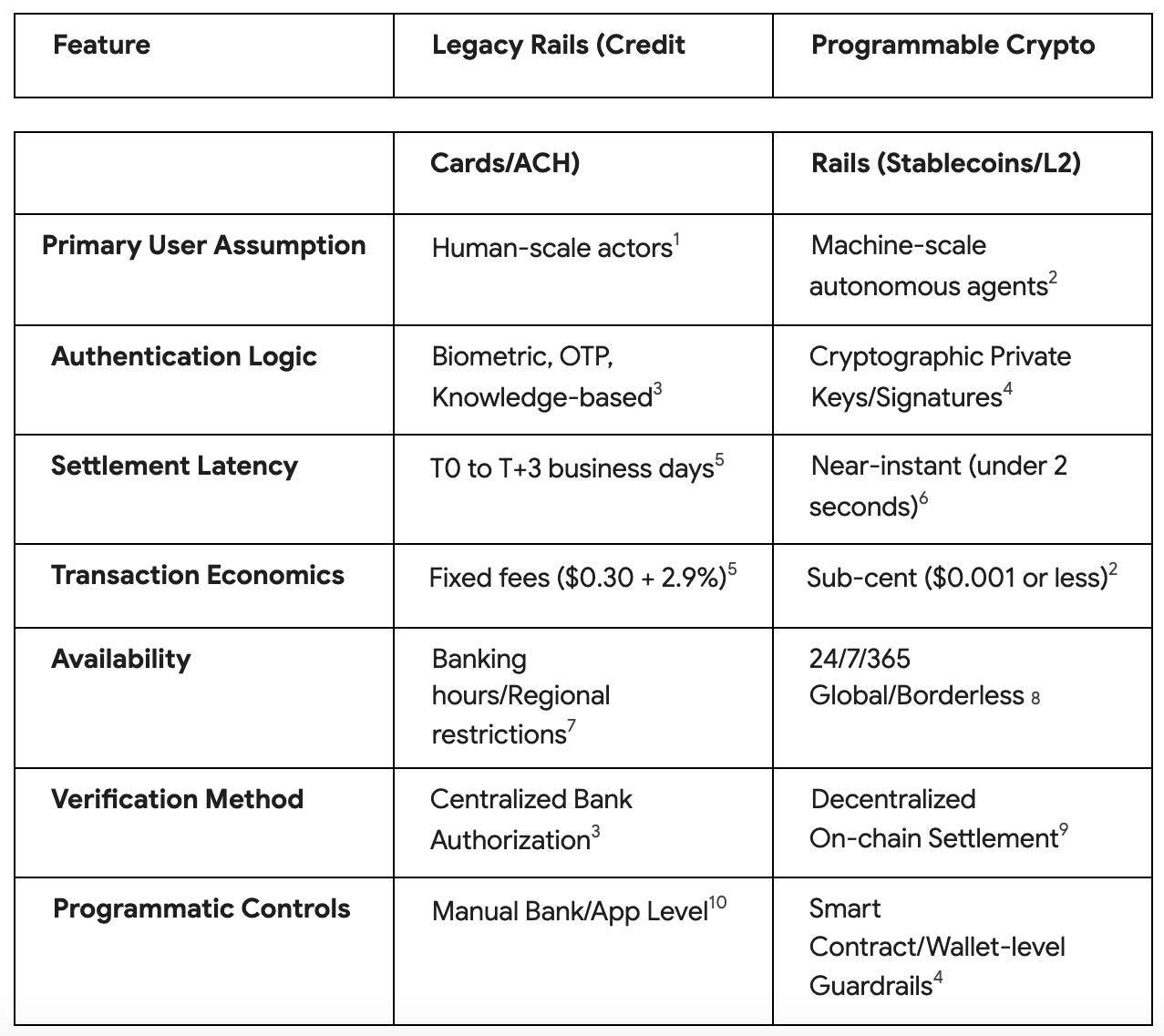
Why Credit Cards Obstruct Agentic Autonomy
The fundamental mismatch between human-centric payment systems and the needs of autonomous agents stems from the “original sin” of the internet: the lack of a native value-transfer layer. For thirty years, digital commerce has relied on overlaying traditional banking systems onto the web, a process that is inherently slow, expensive, and opaque. For an AI agent, these limitations are nonstarters.
The Economic Failure of Micropayments
In the agentic economy, transactions are often measured in fractions of a cent. An agent might pay for a single API call, a specific data point from a researcher, or a few milliseconds of GPU compute. Credit card networks, with their fixed-fee structures—typically $0.30 or more per transaction—can make these interactions economically impossible. On a $0.01 request for market data, a legacy processor’s fee would exceed the transaction value by several thousand percent.5 This creates a high barrier to entry for the machine-to-machine (M2M) economy, forcing developers to use subscription models that lead to underutilization or overpayment. Programmable crypto rails, particularly on networks like Solana or other high-throughput networks and Layer-2 solutions, offer fees of less than $0.0001, enabling the true monetization of granular digital services.12
Anti-Bot Blockers and the Identity Paradox
Traditional payment methods are inextricably tied to human identity verification. Processes such as Know Your Customer (KYC), credit scores, and government-issued IDs are designed to verify biological persons. Much of the internet’s modern security infrastructure, including CAPTCHAs and WAF (Web Application Firewall) rules, is explicitly designed to distinguish humans from machines and block the latter.3 An AI agent attempting to use a credit card to purchase a flight or a data subscription often triggers aggressive fraud detection algorithms that view rapid, cross-platform, automated activity as suspicious.
Latency and the Settlement Mismatch
Legacy systems rely on batch processing and multi-day settlement windows. While a transaction may appear “authorized” instantly, the actual movement of funds takes days. Autonomous agents, which operate in real-time loops, require immediate finality to confirm that a service has been paid for before proceeding to the next step of a task.5 Any delay in the payment verification process breaks the automation loop. In contrast, stablecoin payments on high-performance blockchains achieve finality in seconds, allowing agents to maintain continuous operation.6
Activating the HTTP 402 Status Code
The architectural solution to the legacy bottleneck lies in the revival of the HTTP 402 “Payment Required” status code. Originally included in the HTTP specification in the late 1990s, it remained largely dormant for three decades because the web lacked a native, programmable payment protocol.14 The x402 protocol, developed and open-sourced by Coinbase and now stewarded by the x402 Foundation in partnership with Cloudflare (one of the largest content delivery networks), finally provides the infrastructure needed to operationalize this code.14
The x402 Handshake Mechanism
The x402 protocol embeds payment directly into the web’s request-response cycle. When an agent requests a protected resource, the server responds with an HTTP 402 “Payment Required” status containing structured payment metadata (asset, amount, destination, network). The agent signs a stablecoin authorization and retries the request with proof of payment. Settlement is verified on-chain in milliseconds, and the resource is unlocked, all within a stateless workflow. This mechanism transforms every URL into a potential point of commerce. It enables a “pay-per-use” model that is far more granular than anything TradFi can offer. For example, market data provider CoinGecko has implemented x402 to allow agents to pull real-time crypto data for a flat fee of $0.01 USDC per request, requiring no API keys or monthly subscriptions.
Stripe and the Machine Payments Preview
Recently, Stripe has previewed “machine payments,” adapting its PaymentIntents API for autonomous agents. Instead of web forms for humans, agents receive a unique deposit address per transaction and settle in USDC over Base, a layer-2 solution on Ethereum. Funds reconcile into Stripe’s existing infrastructure, allowing businesses to handle reporting, tax, and accounting without directly managing crypto if they choose not to. Stripe’s release of the open-source tool purl further signals that stablecoin-based settlement is becoming production infrastructure for agent commerce.
This development validates the use of stablecoins and public blockchains as the most viable path for machine commerce by a leading global payment provider. Jeff Weinstein, product lead at Stripe, explicitly noted that the current financial system is incompatible with agent needs, citing the requirement for 24/7 global rails and low-latency finality guarantees that traditional card networks cannot provide.8
Coinbase Launches Agentic Wallet
While Stripe focuses on the seller side of machine payments, Coinbase has introduced a solution to the buyer side with the release of Agentic Wallets. This offers wallet infrastructure specifically designed to give autonomous AI agents their own economic identity.4 Unlike traditional crypto wallets designed for human users, agentic wallets are “headless.” They are controlled via a Command Line Interface (CLI) or through the Model Context Protocol (MCP), allowing agents to independently hold funds, trade tokens, and pay for services.4
Coinbase’s Agentic Wallet enables secure, programmable autonomy:
Key isolation: Private keys remain within Coinbase’s secure enclave and are never exposed to the agent’s LLM, protecting against prompt-injection attacks.
Programmable guardrails: Users can set spending limits, session caps, and allowlists so agents can act autonomously within defined boundaries.
Gasless execution: On Base, transactions can be gas-sponsored, removing the need for agents to manage ETH balances for fees and simplifying execution logic.
Maching-to-Machine Commerce Case Study: ClawRouter
While still early, autonomous agents are already operating within this new paradigm, leveraging APIs and micropayments to optimize task execution. ClawRouter emerged to reduce the cost of running agents on Clawdbot, a popular open-source, self-hosted platformfor launching AI agents. ClawRouter, also open-sourced, is a routing layer that sits between agents and providers, and optimizes across more than 30 model backends, and allows agents to use APIs and per-request payments to deliver more cost-efficient outcomes for their operators.15
Consider how an agent approaches a task. If instructed to build a financial model, it might call Claude to write code, Gemini to research supporting data, and another model to generate a presentation or design assets. Rather than committing to a single provider, the agent evaluates price, performance, and latency across available APIs. Using x402, it can identify the optimal model for each subtask and autonomously settle payment for individual LLM API requests in stablecoins.
This pay-per-inference model, rather than subscription-based access, demonstrates a fundamental shift. Agents do not exhibit brand loyalty or fixed vendor relationships; they optimize for task completion and marginal cost. In practice, this means routing to the cheapest and most performant service in real time, paying only for what is used via micropayments.
Walled Gardens vs. Open Ecosystems
As agentic commerce assumes a more prominent role, we can expect a divergence to emerge between the “walled gardens” of traditional payment providers and the “open protocols” of the Web3 world.
TradFi On The Defensive: Visa TAP and Mastercard Agent Pay
Visa and Mastercard have introduced agent-focused frameworks (e.g., TAP and Agent Pay), designed to preserve card-network dominance. These systems rely on centralized registries, tokenization layers, and merchant-level verification to distinguish trusted agents from malicious bots.18
While suitable for consumer e-commerce, these approaches remain permissioned and siloed. A2A economies, where software pays software across jurisdictions, require open, interoperable rails. Crypto-native protocols satisfy this requirement by design.
The Google/PayPal Middle Ground: AP2 and Mandates
Google and PayPal have proposed the Agent Payments Protocol (AP2) as an open, payment-agnostic governance layer. AP2 does not dictate how the money moves (it supports cards, ACH, or stablecoins) but focuses on authorization.21 AP2’s defining innovation is the “Mandate”—a tamper-proof, cryptographically-signed digital contract that provides verifiable proof of user intent. Crucially, AP2 includes a specific “A2A x402 extension,” developed in partnership with Coinbase and the Ethereum Foundation. This extension allows AP2’s governance framework to trigger x402’s fast, on-chain stablecoin settlement, effectively merging the trust of TradFi with the efficiency of crypto.22
Conclusion: The Sovereign Value Layer of the Internet
The internet was born with an “original sin”: it was designed to move information, not value. For decades, digital commerce relied on human-centric financial infrastructure—credit cards, banking APIs, and fintech overlays—to approximate a native payment layer. Autonomous agents expose the limitations of that patchwork. Systems built around identity verification, batch settlement, and fixed transaction fees cannot support machine-scale economic activity.
Agents remain a nascent application of AI, yet early implementations already demonstrate how stablecoins provide a superior settlement layer for A2A commerce. While stablecoins have long been one of crypto’s most durable use cases, their structural demand may ultimately be accelerated by software. If individuals and enterprises transition from manually interacting with models to managing persistent, 24/7 fleets of agents, commerce may undergo a fundamental shift. Subscription platforms become less efficient, brand loyalty weakens, and purchasing decisions increasingly optimize for marginal cost and task performance in real time.
The financial system of the future will require speed, finality, and programmability by default. We are moving from an era where humans use the web to buy things, to one where autonomous systems native to the web become economic participants in their own right. If agentic systems scale alongside advances in compute and model capability, the total addressable market of digital commerce may expand by orders of magnitude as transaction frequency shifts from human-paced activity to machine-scale execution.
Yet payments may represent only the initial phase of this transition. Over the past decade, crypto infrastructure has reconstructed core financial primitives—spot markets, lending, derivatives, and on-chain liquidity—into programmable, globally accessible systems. As agents become native to these rails, they may not only transact but also allocate capital, hedge risk, access liquidity, and deploy automated strategies directly on-chain. In that context, blockchain networks evolve beyond payment infrastructure into the financial operating system of machine-native capital markets. The intersection of AI and crypto may therefore represent not just incremental adoption, but the emergence of an entirely new layer of digital economic coordination.
Works Cited
1. AI needs blockchains — especially now | a16z crypto | X (Twitter),
https://x.com/a16zcrypto/article/2019119378537832763
2. Welcome to x402 - Coinbase Developer Documentation,
https://docs.cdp.coinbase.com/x402/welcome
3. Enabling the Machine Economy: Payment Rails for AI Agents | by Mitesh Shah | Medium, 7
https://medium.com/@miteshshah/payment-rails-for-ai-agents-enabling-the-machine-e conomy-7f2d12463dc1
4. Coinbase rolls out AI tool to ‘give any agent a wallet’ | The Block,
https://www.theblock.co/post/389524/coinbase-rolls-out-ai-tool-to-give-any-agent-a-w allet?utm_source=companies.xml&utm_medium=rss
5. AI Wants to Shop For You — But Your Credit Card Won’t Let It. Here’s Why. | by Mahesh Lambe | Medium,
https://medium.com/@maheshlambe/ai-wants-to-shop-for-you-but-your-credit-card-w ont-let-it-here-s-why-7b9c0ea665cb
6. Payment Rails for the Age of AI Agents: Analyzing the x402 Protocol, https://www.wepin.io/en/blog/ai-agent-payment-infrastructure-x402-protocol 7. Why Legacy Payment Systems Are Failing Modern Businesses,
https://toucanus.com/blogs/why-legacy-payment-systems-are-failing-modern-business es/
8. Stripe adds x402 integration for USDC agent payments on Base | The Block, https://www.theblock.co/post/389352/stripe-adds-x402-integration-usdc-agent-paymen ts
9. x402, Agentic Payments, and Crypto’s Emerging Role in the AI Agent Economy | Galaxy, https://www.galaxy.com/insights/research/x402-ai-agents-crypto-payments 10. Why Legacy Payment Systems Are Hurting Your Growth (And How to Fix It) - EnKash, https://www.enkash.com/resources/blog/why-legacy-payment-systems-are-hurting-your -growth
11. Ampersend - A wallet for agents - Edge & Node,
https://www.edgeandnode.com/ampersend
12. The Missing HTTP Status Code: How x402 Became Infrastructure for the Machine Economy,
https://boostylabs.com/blog/the-missing-http-status-code-how-x402-became-infrastru cture-for-the-machine-economy
13. AI Agent Payments: Traditional Payment Methods vs. New Solutions - Crossmint Blog, https://blog.crossmint.com/ai-agent-payments/
14. X402 Protocol: What It Is, How It Works, and Why It Matters | by Marko Vidrih - Medium, https://vidrihmarko.medium.com/x402-protocol-what-it-is-how-it-works-and-why-it-mat ters-2b6bc889ee7f
15. ClawRouter: Anthropic Charged Me $4,660 — How I Cut It 70% With Smart LLM Routing | by AgentNativeDev | Medium,
https://agentnativedev.medium.com/clawrouter-anthropic-charged-me-4-660-how-i-cut -it-70-with-smart-llm-routing-cb0520040fa0
16. Announcing official MCP support for Google services | Google Cloud Blog, https://cloud.google.com/blog/products/ai-machine-learning/announcing-official-mcp-su pport-for-google-services
17. WebMCP is available for early preview | Blog | Chrome for Developers, https://developer.chrome.com/blog/webmcp-epp
18. Visa Introduces Trusted Agent Protocol: An Ecosystem-Led Framework for AI Commerce, 8
https://investor.visa.com/news/news-details/2025/Visa-Introduces-Trusted-Agent-Protoc ol-An-Ecosystem-Led-Framework-for-AI-Commerce/default.aspx
19. Designing with Mastercard Agent Pay: How Banks Can Win the Agentic Commerce Era | by Seyhun AKYÜREK | Medium,
https://medium.com/@seyhunak/designing-with-mastercard-agent-pay-how-banks-can win-the-agentic-commerce-era-54d3cc60d091
20. How Ampersend Is Building the Command Center for the $30 Trillion Agentic Economy, https://hackernoon.com/how-ampersend-is-building-the-command-center-for-the-$30 -trillion-agentic-economy
21. An Overview of Agentic Payment | New Protocols, PSPs and...,
https://www.gctechallies.com/post/an-overview-of-the-psp-space-focus-on-agentic-pa yment
22. IOSG Weekly Brief|x402 - A New Standard for Crypto Payments by Digital Agents - Bitget, https://www.bitget.com/news/detail/12560605033831